
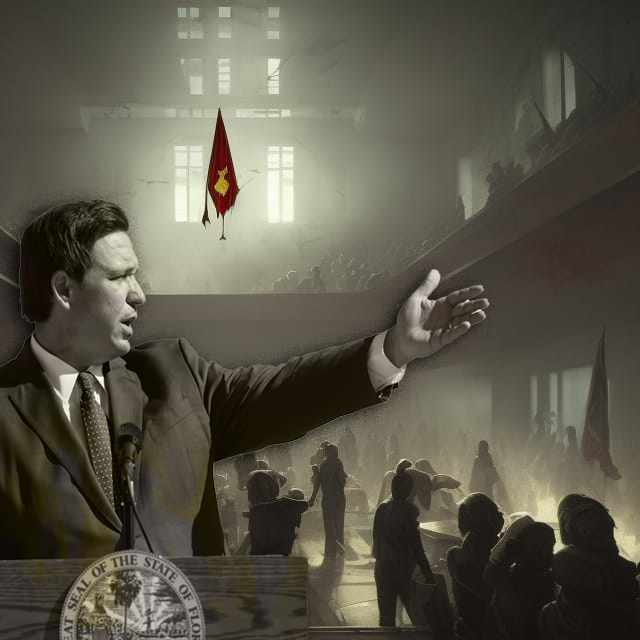
IT’S FASCISM. HERE’S WHY…
fascism, Communism and authoritarianism
During discussions about my latest adventures here in the Free State, namely having my books removed from my classroom and being put under investigation for my position on Florida’s pronoun laws, the responses I have received have been overwhelmingly supportive. I have, however, noticed an interesting dichotomy in how this issue is being defined. Often whomever I’m speaking with agrees with my assertion that these policies are fascist in nature. Others respond, “Wow! this sounds like communism!”
So, which is it?
It’s fascism. Let me explain.
The confusion between fascism and what I will refer to as real-existing communism1 has to do with totalitarianism as an outcome. In both fascist and communist nations we see similar results. A single party, under the leadership of a cultish central figure, takes control of all aspects of the political economy and denies basic human rights to its citizens. The state takes on the responsibility of providing for the citizens. In exchange, the state demands total obedience and subservience of the citizens. This state is held together by strictly controlling the discourse, overt threats of brutal state terror, and the certainty of covert surveillance.
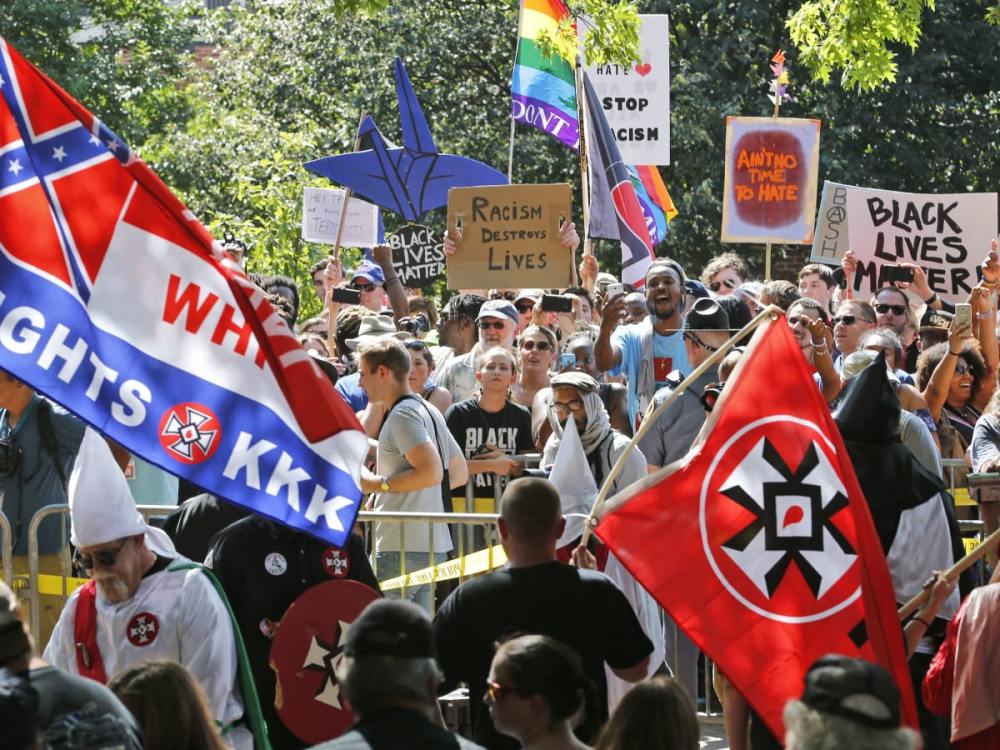
That sure sounds like the MAGA endgame and the miasmic atmosphere here in the Free State of DeSantis. So, what makes MAGA a fascist movement rather than a communist movement?
A nation run according to totalitarian principles requires certain structures to be in place, regardless of whether it is a right-wing fascist government, or a left-wing communist government. That’s why the end results are the same. A dominant central authority. Policing authority with unquestionable power and no accountability. Ubiquitous surveillance, often by enlisting citizens to spy on citizens. Enforced ideological uniformity…what could be called indoctrination. Left-wing and right-wing movements, intent on authoritarianism, must have structures in place to perform these tasks, or they won’t last long.
What differentiates a left-wing socialist or communist totalitarianism from right-wing fascist totalitarianism2 breaks down into two elements. The first has to do with the rhetoric and the discourse used to motivate people to participate in the movement. The second involves the expressed goals of the movement as opposed to the outcomes.
Discourse and Rhetorical Formations
In each case, both communists3 and fascists often turn to those members of the society who feel disregarded. This often means focusing on the poor and working-class, but neither ideology will shun sympathetic members of the middle-class. Fascism, however, is much more likely to gain traction among the upper classes or the economic elite for reasons that will become clear below.
For communists, in the socialist wheelhouse, rhetoric is based on class distinctions, or what Marx described as a dialectic. On one hand, we have the class of workers and the poor, the proletariat, who do the work that drives the economy. On the other is the wealthy capitalist class who reap the benefits by stealing the surplus value from those who do the work.
Consequently, communist rhetoric focuses on class and economic injustice. The selling point is that we need to restructure society in such a way that wealth and class no longer matter. Indeed, communists believe in eliminating class altogether. They embrace the socialist position that the means of production should be democratically controlled by “the people” dedicated to meeting each other’s needs rather than by individuals intent on profit and control. What distinguishes communism from socialism overall is its emphasis on communal ownership of the means of production over other arrangements.
This is what makes the rhetoric left-wing. The political left is dedicated to changing the social order in the interest of greater freedom, justice, and equality. The rhetoric is also radical because it identifies almost all social problems as resulting from a single source–capitalism. By eliminating that variable, the goal is to usher in a totally transformed social order. This would be a society the world has never seen, arguably, since the end of our primitive tribal existence and the beginning of urban civilization based on surplus agriculture. The rhetorical goal is to create something new because the status quo does not work.
Fascist rhetoric has a different focus. Like communists, fascists also want to transform society. Their goal, however, is not to create a new, utopian kind of society. Rather, fascists want to restore the society to its glorious past when it was powerful, and wealthy, and…um…great.4 This once glorious past is mostly mythological, which makes it powerful propaganda. Communists can refer to a utopian world that never existed and reach a large audience because everyone has somewhat different ideas about what that utopia looks like. So long as the communist doesn’t get too specific, everyone is satisfied. Same is true for MAGA. Everyone has a somewhat different vision of what the United States was like when it was great. So long as MAGA leaders don’t offer too many details, the propaganda works.
Fascist rhetoric focuses on a concept of The Nation rather than on class. This makes fascism a nationalist5 ideology. It also makes it more attractive to members of the class that would be overthrown by communists. For fascists, the source of a nation’s social problems is that the people have strayed from the core values that made the nation great to begin with. Why did the people stray? Because we became too tolerant, too liberal, too democratic. We allowed foreign, culturally inferior ideas to replace our strong traditions. Our superior culture has atrophied. For fascists, this atrophy can be blamed on “those people.” Those people may be liberals or leftists, atheists, and homosexuals and other sexual minorities. People with mental disabilities are also common targets for fascists. Sometimes, especially for branches of fascism like Nazism, those people represent ethnic or racial minorities, as well as the scapegoated group of choice, Jews.6
This is what makes fascism a right-wing ideology. The goal is not to create a new and better world, as is the focus of the left. Rather, the goal is the continuity of traditional values that may be lost if we keep listening to liberal and leftist propaganda about tolerance and equality. Politically, liberals, or “the left” are those dedicated to social change, while conservatives or “the right” are dedicated to continuity and social stability.
Goals vs. Outcomes
This begs the question, if the goals are so different, why were the outcomes between fascism and real-existing communism so similar? The answer has to do with the practical contingencies of power. There is a difference between how fascist and communist ideologues understand power, and the ways in which fascists and communists holding power put it into practice.
First, let’s take a look at the utopian world as understood by communists. When communists look to the future, having accomplished all their goals, what they see is a world in which property is own communally (hence the name) and is used to the betterment of all. As theorized by Marx, society would exist to benefit all people, “From each according to his ability, to each according to his needs.” It is a world without social classes, without money. Furthermore it is a world without a dominant state. Communists believe that the state exists in order to sustain economic classes. When class is no longer a factor, the state becomes irrelevant and will fade away. What most people don’t realize is that communism is a small-d democratic ideology.
I don’t know. Sounds pretty nice!
So, what happened?
Well, we have this vision of a pretty cool world, as opposed to the world that we are living in? Okay. How do we get there? It really isn’t clear.
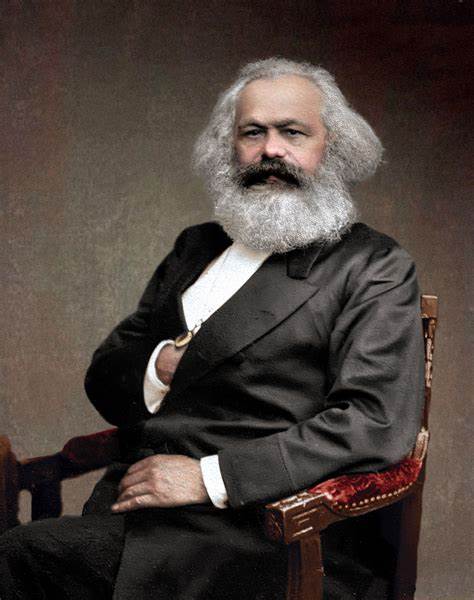
This is where Karl Marx comes into the picture. Marx saw communism as the innevitable outcome of capitalist excess. For Marx, the proletariat will ultimately start to shake off the false consciousness imposed by capitalists, namely that capitalism is the right and natural state of social arrangements and that everyone is in a state of perpetual competition with each other for resources and status–the winners get the resources and status as it should be. Instead, the proletariat will develop a class consciousness in which all workers realize that they are all being exploited and have the same interests. Black, white, man, woman, Italian, French…these distinctions would become unimportant as the proletariat grows to understands that it is better to coopwerate a global class.
Then, capitalism will fall into a crisis and collapse from its own excesses. It will overproduce and prices will spiral, creating a global recession from which there is no way out. At this point, the unified proletariat will rise up, seize control of the state and institute a “dictatorship of the proletariat”. This dictatorship will, during a brief period of socialism, dismantle capitalism, outlaw private property and distribute the means of production into the hands of “the people”. Once that is achieved, the communist utopia will be at hand.
Awesome! Um…how’s that supposed to happen?
Marx wasn’t really clear on this. Indeed, contrary to popular belief, Marx really didn’t offer many ideas with regard to government. His analysis and critique was strictly economic. It fell to later theorists to figure out the mechanics of this dictatorship of the proletariat. The most influential of these mechanics was a fellow named Vladimir Lenin.
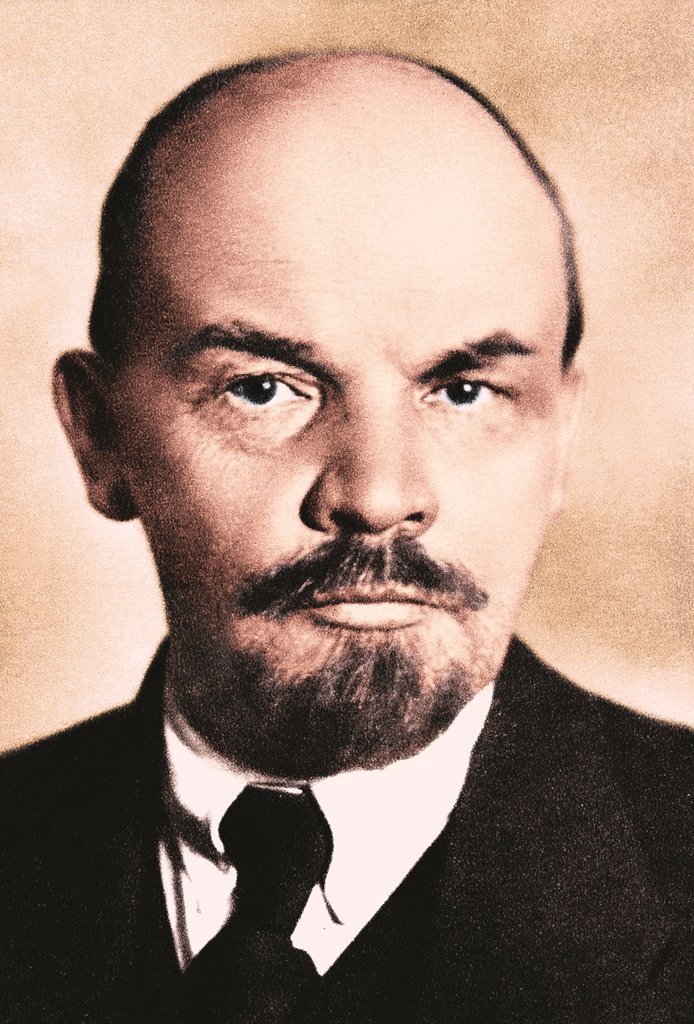
Lenin believed that, for the revolution of the proletariat and the seizure of the state to really happen, an intellectual elite, dedicated to Marx’s principles of historical materialism, would have serve as a “vanguard of the oppressed.”7This vanguard would seize control of the state and, step by step, usher in the communist utopia. This would not be a democratic process. It would, by design, be brutal. According to Lenin in his essay State and Revolution, a “democracy for the poor…” would not be democratic. Rather, it would be focused on destroying capitalism. Toward this end, the vanguard led dictatorship of the proletariat would institute “…a series of restrictions of liberty in the case of the oppressors [the capitalists]…We must crush them in order to free humanity from wage-slavery; their resistance must be broken by force; it is clear that where there is suppression there is also violence, there is no liberty, no democracy.”
There it is. According to Lenin, democracy would have to take a temporary back seat to brutal authoritarianism in the interests of the poor. “Only in Communist society, when the resistance of the capitalists has been completely broken…only then (emphasis in original) ‘the state ceases to exist,’ and ‘it becomes possible to speak of freedom.'”8 Lenin is saying, in essence, “We’ll lead the revolution. We’ll take over the state. We’ll bring about the communist utopia. Then we’ll step down graciously. Trust us!”

The nineteenth century anarchist theorist Mikail Bakunin almost presciently identified the flaw in Marx’s concept of the dictatorship of the proletariat. He pointed out, “obeying the iron law, according to which the social position of a given
person outweighs as a determining factor his subjective wishes, they serve the cause of reaction, without even being aware of it .. .”9 In other words, once these yahoos take power, their focus will change, whether they know it or not, to keeping power. And that’s exactly what happened.
In 1917, Lenin and his Bolshevik party took control of the new Russian government during the October Revolution. He then started to implement his vanguardist policies. This culminated in a bloody civil war that lasted almost six years. In that time Lenin consolidated power into the the state that he controlled. Was he sincere in his desire to usher in the communist utopia and, like Cincinatus, step down and retire into the countryside? It’s impossible to say. Lenin himself suffered a debilitating stroke before stepping down and was usurped by Joseph Stalin…who was certainly not intent on stepping down.
The rest as they say, is history. Russia descended into brutal totalitarianism. This is also true for those eastern block countries who fell under Russia’s authority. The same pattern was repeated in China under Mao. Those nations adopting communism through the Marxist/Leninist model, the only successful communist model to date, have all descended into some level of authoritarianism. To date, none are the stateless, classless utopias as imagined by Marx and contemporary communists.
As it stands, it looks like communist movements tend to devolve into authoritarianism and even totalitarianism despite the democratic pretensions of movement ideologues. The practical realities of revolutionary transformation empowers the state. Once empowered, the state and those at its helm, are uninclined to let it go. This comports with my concept of the Primary Function of Institutions. The primary function of any institution is the perpetuation of the institution. All other functions are secondary. Bakunin was right.
This leads us to the distinction between communism and fascism as it relates to authoritarianism and ultimately to totalitarianism. For communism, authoritarianism is a bug in the process. No communists support the notion of a totalitarian state as the end goal. For some communists, any authoritarian state is only tolerable in so far as it is a temporary expedient to the end goal of a democratic, egalitarian society. Many socialists and communists embraced the Soviet Union until it became obvious that the “dictatorship” did not exist in the interests of any “proletariat”. Most then turn their backs on the Marxist/Leninist model.
This is not the case with fascism. For fascists, authoritarianism is the feature. It is consistent with the goals of movement ideologues. According to fascist philosophy, the underlying problem is “those people” who have too much power over the nation and are using that power to subjugate the “true and rightful” citizens. The existing liberal democratic state is powerless to do anything about this foreign usurpation. It then falls to the fascists to overthrow the existing state and to install a capable, irresistable authoritarian who will use his force of will and the power of the state to rid the nation of those people and restore rightful citizens to their rightful dominant status.
The more power this authoritarian has, the better he will be in restoring the nation to greatness. He must be given the power to do what he sees fit for the nation. After all, there are cabals and conspiracies all around trying to take him down. He must be imbued with unlimited power to ensure that we, the true citizens, will benefit from our nation’s greatness while the undeserving others will not be allowed to take advantage of what “we” have built. Toward that end, all true citizens must be faithfully dedicated to the authoritarian. Any slight against the authoritarian is a slight against all of the true citizens in whose interests the authoritarian rules.
Conclusion
Authoritarianism, and its ultimate expression, totalitarianism is exercised in modern societies in particular ways regardless of the ideological underpinnings supporting it. Totalitarians must consolidate state power under their authority. They can brook no other legitimate claims to authority. Totalitarians must control every medium of discourse within a given society, allowing for no ideas that might be critical of the authoritarian. In such a society the police must have unquestioned authority, even to the point of imposing capital punishment on those who challenge them. A surveillance system must be in place to ensure the unquestioned obedience of everyone under authoritarian jurisdiction. This means recruiting citizens as spies against their neighbors and even family members. Finally, good ol’ fashioned bigotry is a great tool for creating the kind of in-group solidarity necessary to sustain an authoritarian regime.
These characteristics must be in place to greater or lessor extents in all authoritarian states. The degree to which they are present is a reliable measure of the level of authoritarianism under which the citizens are subject. This is true for left-wing authoritarian regimes. It is also true for right-wing authoritarian regimes. Regardless, the outcomes are similar.
It is, however, important to understand the motives and ideological impetus for authoritarian movements in any given society. Understanding the motives and movement dynamics offers an avenue by which to resist and intercede before the authoritarians can assert too much power. That’s why it is, in my mind, necessary to point out that the MAGA movement and the current state apparatus in Florida among other states, is not just conservatism, or alt-right. It is not good enough to refer to this crowd as “authoritarian”. We must admit to ourselves, and communicate to others, that what we are seeing is ascendent fascism. It can happen and is happening here.
- Referencing the concept of real-existing socialism, or socialism as it has manifested in the major countries that adopted it as a dominant political paradigm. In other words, real-existing communism/socialism is a political economy in which the state controls the means of production. ↩︎
- We can also talk about right-wing theological totalitarianism as a phenomenon in and of itself. Indeed, I will almost certainly be taking a closer look at the theological elements of American fascism later on. ↩︎
- At this point I’m going to use Communist, Socialist, and Leftist mostly interchangeably. This is not accurate, but for the purposes of this post, it works. ↩︎
- I want to make clear that slogans like “Make America Great Again,” or “Make Germany Great Again” are common fascist rhetorical formations. I’m not a purist on this. Someone who wants to make America great again isn’t necessarily a fascist. But all fascists do rally around this slogan. ↩︎
- Important to note that Nationalism is not necessarily exclusively right-wing. Left wing nationalists are intent on creating a nation that does not currently exist based on certain concepts of what the nation is. Our founding fathers would have been liberal nationalists during the revolution. Conservative nationalism, however, focuses on the traditional values as crucial to the nation’s perpetuity. Many of our founders, once the United States was established, became conservative in their goals for national continuity. ↩︎
- We cannot ignore the fact that communism also “others” a group of people. In this case, the “those people” responsible for our social problems are capitalists. And, of course, consistent with this rhetoric in real exsting communism is special scapegoating of, yes, you guessed it, Jews…who are accused of being the cabal controlling capitalist finance. Bottom line, when it comes to consolidating group identity around an authoritarian ideology, there’s no better tool than scapegoating an other. ↩︎
- Lenin V. I. State and Revolution, Chapter 5 Section 2 ↩︎
- Lenin is quoting Engels here. ↩︎
- Quoted in Hodges, D. C. (1960). Bakunin’s Controversy with Marx: An Analysis of the Tensions within Modern Socialism. The American Journal of Economics and Sociology, 19(3), 259–274. http://www.jstor.org/stable/3484980 ↩︎

 Dangerous Knowledge